
From Autumnal Japan: New Acquisitions
I’ve just returned from a buying trip to beautiful autumnal Japan, which is currently experiencing an overwhelming volume of tourists - apparently now one of the world’s top holiday destinations! I was shocked to find that it is now extremely difficult to buy high grade matcha or even quality Japanese-made tea whisks! Despite it just being a short trip, I managed to visit a couple of major exhibitions that offered historical depth and fresh perspectives on Japanese ceramics and works of art.
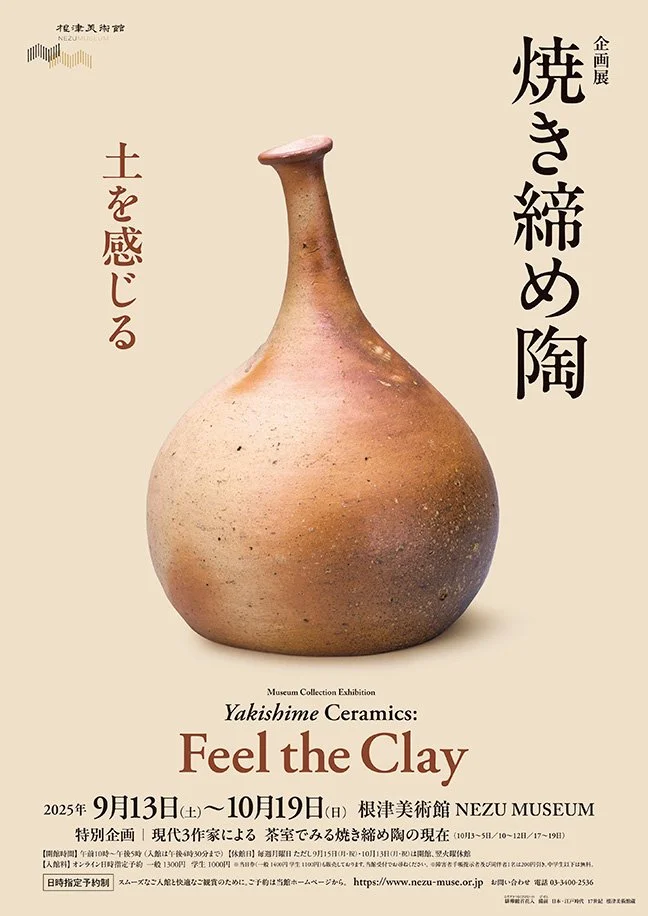
One of the best I have seen in years was at the Nezu Museum - “Yakishime Ceramics: Feel the Clay” traced the lineage of unglazed, high-fired ceramics from the Heian and Kamakura period through the great explosion of native Japanese tea wares of the Momoyama period, all the way through to the modern era of the Momoyama revivalists. The exhibition focused on the six ancient kilns, presenting a rare concentration of works that exposed the enduring power of raw clay, fire, and form. The curated works offered a vivid reminder of how minimal intervention and the happy utilisation of accidental kiln effects can yield profound aesthetic impact.

In Kyoto, I visited the Kyocera Museum for the major exhibition “100 Years of Mingei - Kyoto’s Legacy of Everyday Beauty.” This show commemorated the centenary of the Mingei movement founded by Yanagi Sōetsu, Shōji Hamada, and Kawai Kanjirō, presenting their works with remarkable clarity and breadth. One of the most compelling aspects of the exhibition was its inclusion of an impressive number of wooden sculptures by Mokujiki, the Buddhist sculptor whose expressive folk sculpture - carved more than a century before the emergence of Mingei - deeply influenced the movement's philosophy of minimally adorned, humble beauty. Seeing his sculptures contextualized alongside the work of all of the famous members of the Mingei movement brought a rare perspective on the lineage of “everyday beauty” in the world of utilitarian Japanese arts.
It always feels like a privilege to attend exhibitions like these in Japan, where the ability to curate innovative exhibitions has not been lost.
Below are some highlights from the pieces I acquired on this trip, with further additions to follow on the website. If you would like further details or condition reports, feel free to contact me directly.
Highlights from the Recent Acquisitions
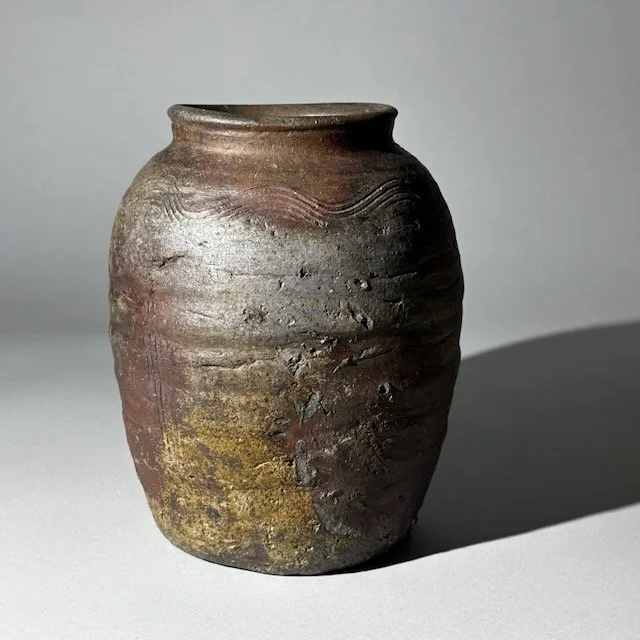
Ko-Bizen tsubo, Muromachi period
An excellent example of early Bizen ware, with the characteristic dark yet warm, iron surface blush and strong, functional form associated with medieval production. The piece shows the quiet strength and natural firing effects valued in early Bizen wares including goma (sesame) glaze splattering, a wonderful mark to one side where another vessel stuck to it in the firing, and small stone inclusions in the clay, all of which are considered part of the keshiki (landscape or scenery) prized in yakishime (unglazed) Japanese ceramics.

Ko-Hagi chawan, early Edo period
A classic early Hagi tea bowl with a subtle but characterful glaze, and the warmth from long use that gives early Hagi its fame amongst tea connoisseurs. Its understated presence and refined imperfections make it a particularly good example of the type.

Large bronze offering bowl, Nambokuchō period
A substantial Buddhist offering bowl finely decorated with incised scrolling floral motifs (shown below). The scale, weight, and quality of the decoration speak to its temple origins. Surviving examples of this size and period are uncommon

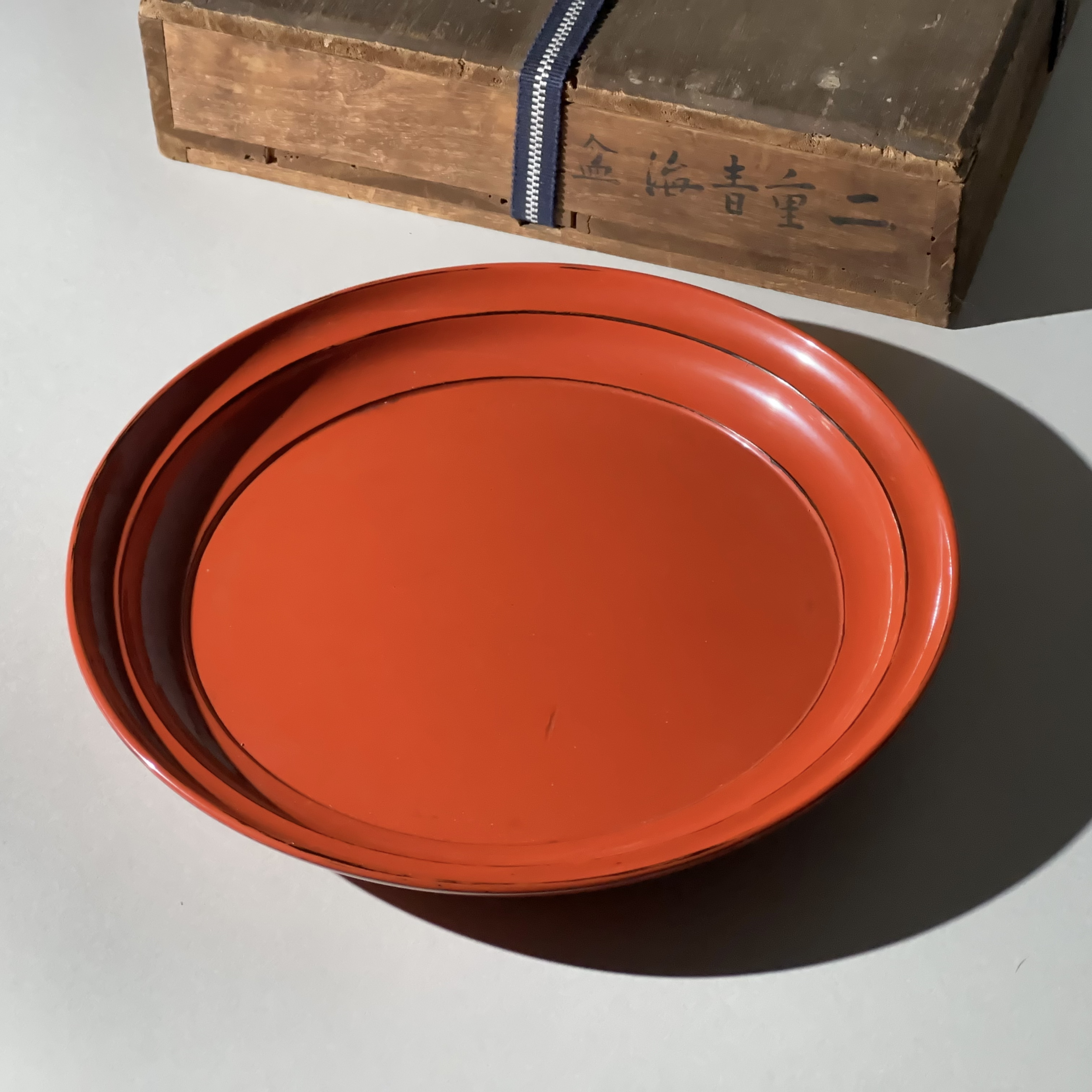
Negoro higashibon, Momoyama period
A very fine and well-preserved negoro lacquer tray, of a rare type with a double cavetto. A strong example of minimalist Momoyama-period design for use as either a tray to serve dry sweets or to elevate a chaire in tea ceremony.

Mage-kago inscribed by Zuiryusai, early Edo period
Formed as a simple and elegant basket of bent softwood with high overarching handle, coated with a rich thin brown lacquer, a rare survivor from the 17th century for use as a chabana (tea flowers) vessel, embellished with a red lacquer inscription by Zuiryusai (1650-1691), fifth generation iemoto of the Omotesenke School of tea.

Kosometsuke/Shoto-yaki four-sided mizusashi, Tianqi period
In square form, this unusual mizusashi is decorated with the Four Gentlemen - bamboo, orchid, chrysanthemum and plum – a classical Chinese theme symbolising the virtues of purity, humility, uprightness and strength in adversity, each also representing a different season. Of note is the painterly quality of the decoration, in a vibrant hue of underglaze blue, but with a soft quality due to the thickness and flow of the glaze.

Kosometsuke dish with magpies and plum, accented with copper red, Tianqi period
A kosometsuke dish of rare design featuring two magpies, one perched in a plum tree, the other flying in to greet the first, framed by heavily stylised clouds. The design including the addition of underglaze copper red accents - technically difficult and seldom seen in pieces of this genre - mark it as a rare and fine example.

Nankin-akae dish with strolling lovers, Tianqi period
A charming dish decorated in underglaze blue and overglaze enamels, depicting two strolling lovers in a garden, an evocative example of the lively romantic narratives that are often a key feature in Japanese art and design.

Octagonal shonzui tokkuri, Chongzhen period
A rare shonzui sake flask with an octagonal body, decorated in dense underglaze blue vertical registers of alternating diaper and brocade patterns characteristic of high-quality shonzui ware. The form and crisp execution mark it as a museum-level piece.

Kakiemon octagonal bowl, early Edo period
A refined example of nigoshide porcelain in an octagonal form, decorated in clear, well-balanced Kakiemon enamels with reserves containing figures painted in a literati style. The whiteness of the body and precision of the enamels exemplify the best of late 17th-century Kakiemon work.

Chawan with waka poem by Otagaki Rengetsu (1791-1875), late Edo period
A poetic and intimate tea bowl of low and wide form for use in the summer season, inscribed with Rengetsu’s waka translating to:
Here in the shallows
warriors vied to cross
their names carried
to fame and oblivion
on the waters of Uji River.
The calligraphy is fluid and expressive, and the bowl has the quiet but powerful presence associated with her most appealing works.
(translation courtesy of the Rengetsu Foundation)
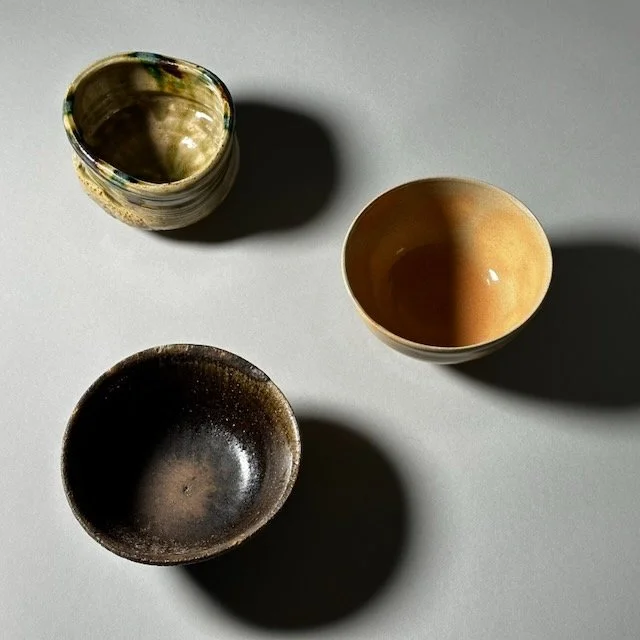
Tea bowls, late Shōwa and Heisei periods
A selection (only three are shown here) of affordable yet beautiful tea bowls by established and mid-career potters from the late Shōwa to Heisei periods. Included is an unusual gohon-chawan by Sugimoto Sadamitsu (1935-), (pictured below) notable for its glaze quality and restrained, modern interpretation of the gohon style made during a point in his career where he focused on making tea bowls in the 16th century Korean style.
